Types Of Soles In Sports Shoes | Better Comfort and Performance
The sole is one of the most important parts of a sports shoe because it determines how your feet interact with the ground. It affects grip, cushioning, stability, flexibility, weight, and durability. Whether you are running, playing basketball, training at the gym, or walking on a court, the right sole can make a noticeable difference in comfort and performance.
There is no single best sole for every sport. Running shoes often prioritize cushioning and efficient movement, while basketball shoes need strong traction and lateral stability. Trail shoes require aggressive grip, whereas indoor court shoes usually need non-marking outsoles.
Understanding the types of soles in sports shoes helps you choose footwear based on your activity instead of selecting a shoe simply because it looks comfortable.
Why the Sole Matters in Sports Shoes?
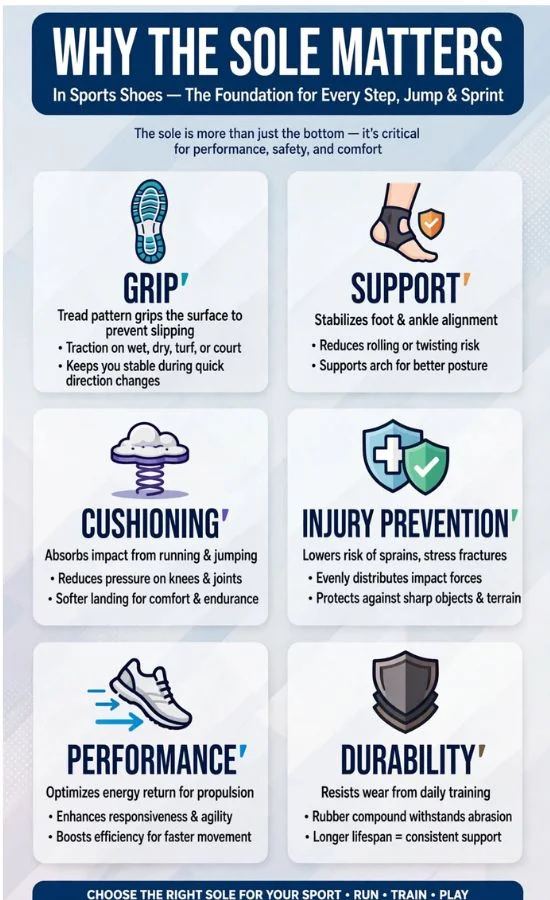
A sports shoe sole has to handle repeated impact and movement. Every step, jump, landing, sprint, or sudden change of direction places different forces on the footwear.
A well-designed sole can help provide:
- Traction against the playing or walking surface
- Cushioning from repeated impact
- Stability during movement
- Flexibility at the appropriate part of the foot
- Protection from rough surfaces
- Resistance to abrasion
- Efficient energy transfer
- Comfortable ground contact
The sole is usually not one solid material. Modern athletic footwear commonly combines a midsole and outsole, with some shoes also using additional layers or inserts.
Main Parts of a Sports Shoe Sole
Understanding the different layers makes it easier to compare sole types.
Midsole
The midsole sits between the foot and outsole. Its primary functions include cushioning, impact management, and helping control the movement of the foot.
Common midsole materials include EVA, polyurethane, and newer proprietary foam compounds.
Outsole
The outsole is the portion that directly contacts the ground. It is responsible for much of the shoe’s traction and resistance to surface wear.
Rubber and rubber-like compounds are commonly used for outsoles because they can provide grip and durability.
Insole
Although technically separate from the sole structure, the removable or built-in insole sits inside the shoe beneath the foot. It can influence comfort and fit but should not be confused with the outsole.
EVA Foam Soles
EVA, or ethylene-vinyl acetate, is one of the most common materials used in athletic footwear.
It is valued for being lightweight and capable of providing cushioning. EVA can be formulated at different densities, so two shoes labeled as using EVA may feel quite different.
Advantages of EVA
- Lightweight construction
- Good cushioning
- Flexible feel
- Comfortable for walking and running
- Relatively easy to mold
- Useful for reducing overall shoe weight
Limitations of EVA
Traditional EVA foam can lose some of its original cushioning properties after extensive repeated compression. The rate depends on the formulation, density, usage, and shoe construction.
EVA is particularly useful when manufacturers want a comfortable shoe without making it excessively heavy.
Rubber Outsoles
Rubber is one of the most important outsole materials in sports footwear.
It offers good abrasion resistance and can provide strong traction when paired with an appropriate tread pattern and compound.
Rubber can be found in running shoes, basketball shoes, tennis shoes, hiking footwear, training shoes, and many other athletic designs.
Why Rubber Is Popular
Rubber can withstand repeated contact with hard surfaces better than many softer foam materials. It can also be formulated for different levels of grip and durability.
However, rubber is generally denser than many foam materials, so using large amounts of rubber can increase shoe weight.
Carbon Rubber Soles
Carbon rubber is a rubber compound modified with carbon materials to increase durability.
It is often used in areas exposed to substantial abrasion, particularly the heel and other high-wear zones.
Where Carbon Rubber Works Best
Carbon rubber can be useful for:
- Running shoes
- Training shoes
- Court footwear
- Walking shoes
- High-abrasion outsole sections
The trade-off is that a highly durable rubber compound may not feel as soft or flexible as a lighter foam-based material.
Blown Rubber Soles
Blown rubber is a lighter type of rubber compound that is processed to create a lower-density structure.
It can provide a softer and more flexible feel than harder outsole rubber.
Blown Rubber vs Carbon Rubber
Blown rubber is generally chosen when manufacturers want to balance cushioning, flexibility, and weight.
Carbon rubber tends to emphasize durability.
Some athletic shoes use both materials, placing tougher rubber in high-wear areas and lighter rubber in other sections.
TPU Soles
TPU stands for thermoplastic polyurethane. It can be used in different parts of athletic footwear, including outsole components, support structures, and cushioning systems.
TPU is known for durability, flexibility, and resistance to abrasion.
Benefits of TPU
TPU can provide:
- Good wear resistance
- Structural support
- Flexibility
- Strong material consistency
- Resistance to oils and some chemicals
Because TPU can be relatively dense, it is not always the first choice when minimizing shoe weight is the primary objective.
PU Soles
Polyurethane, commonly called PU, is another synthetic material used in footwear.
PU can offer cushioning and durability, although its performance depends heavily on the specific formulation.
Where PU Is Useful
PU can work well in footwear designed for:
- Training
- Walking
- Work-related athletic activities
- Casual sports use
- Long periods of standing
Some PU formulations are more resistant to abrasion and compression than basic foam materials, although they can have their own aging characteristics.
TPR Soles
TPR stands for thermoplastic rubber. It combines characteristics of thermoplastic materials and rubber.
TPR soles can provide a useful balance of flexibility, traction, and durability.
They are used in various casual and athletic footwear designs, although high-performance sports shoes may rely on more specialized compounds tailored to a particular activity.
TPR Characteristics
TPR can be:
- Flexible
- Moldable
- Relatively durable
- Suitable for different tread designs
- Available in different hardness levels
Performance depends on the formulation rather than the TPR label alone.
Phylon Soles
Phylon is a lightweight foam material commonly associated with athletic footwear. It is typically produced from EVA-based foam through a molding process.
Phylon can offer a lightweight and responsive feel while maintaining useful cushioning.
Why Sports Shoes Use Phylon
Phylon is useful when a manufacturer wants to create a shaped midsole that balances:
- Low weight
- Cushioning
- Flexibility
- Consistent construction
It is especially common in sports and lifestyle footwear.
PU Foam Soles
PU foam can be used for cushioning and structural support. Compared with some lightweight EVA foams, PU can offer a different balance of durability and cushioning.
Its density can vary significantly.
A firmer PU construction may feel stable, while a softer formulation may emphasize comfort.
TPU Plate and Support Components
Not every sole material is used simply as a full outsole.
Some sports shoes include TPU components within the sole structure to increase stability or control unwanted movement.
For example, a shoe may use soft foam for cushioning but add a firmer thermoplastic component to help stabilize the foot.
This demonstrates why evaluating the complete sole design is often more useful than looking at one material.
Carbon-Fiber Plate Soles
Carbon-fiber plates are not conventional outsole materials. Instead, they are rigid components embedded within some performance-oriented running shoes.
They can increase longitudinal stiffness and alter the mechanical behavior of the shoe during running.
Why Running Shoes Use Carbon Plates
Carbon plates are commonly associated with racing shoes because they can work with highly responsive foam systems to create a stiff, propulsive platform.
They are not necessary for everyday running, and their feel is different from traditional flexible running shoes.
Trail Shoe Lugged Soles
Trail running shoes require a different outsole design from road-running shoes.
Instead of focusing primarily on smooth pavement contact, trail shoes often use pronounced lugs or knobs underneath the shoe.
These protrusions can improve traction on dirt, loose gravel, mud, and uneven terrain.
Deep Lugs vs Shallow Lugs
Deep lugs are generally useful for softer or loose terrain because they can penetrate the surface more effectively.
Shallow lugs may be more comfortable and efficient on hard-packed trails and mixed terrain.
The ideal lug pattern depends on the environment rather than simply the depth.
Road Running Shoe Soles
Road-running shoes are designed primarily for pavement, asphalt, sidewalks, and other relatively hard surfaces.
Their outsoles generally use flatter or strategically patterned rubber sections compared with aggressive trail shoes.
The midsole often receives greater attention because cushioning and smooth transitions are important for repetitive forward movement.
What to Look For
For road running, consider:
- Appropriate cushioning
- Comfortable heel-to-toe transition
- Durable rubber placement
- Suitable flexibility
- Secure fit
- Weight appropriate for your running style
Basketball Shoe Soles
Basketball footwear requires excellent traction and stability because players frequently accelerate, stop, jump, and move sideways.
Outsoles commonly feature patterned rubber designed for indoor court surfaces.
Why Lateral Grip Matters
Running primarily involves forward movement, while basketball involves frequent lateral changes of direction.
A basketball sole therefore needs to provide reliable contact during side-to-side movements.
A basketball shoe can have excellent traction without being suitable for long-distance running because its sole is designed around a different movement pattern.
Tennis Shoe Soles
Tennis shoes are designed around court movement, which includes lateral shuffling, rapid stops, and repeated directional changes.
The outsole pattern depends partly on the court surface.
Hard-court shoes generally need strong abrasion resistance because the surface can be demanding on the outsole.
Clay-court shoes often use specialized tread patterns designed to interact with loose clay while supporting controlled sliding.
Volleyball Shoe Soles
Indoor volleyball shoes generally emphasize grip, stability, and quick movement.
Non-marking rubber outsoles are commonly used for indoor court surfaces.
The sole needs to support rapid lateral movements and jumping while maintaining reliable contact with the floor.
Why Non-Marking Rubber Is Important
Indoor sports facilities may require non-marking footwear to protect the court surface.
Always check the facility’s footwear rules before playing.
Soccer Shoe Soles
Soccer footwear has specialized outsoles designed around the playing surface.
Firm-ground cleats use molded studs, while artificial-turf and indoor shoes use different traction systems.
Stud Configuration Matters
The shape, number, and arrangement of studs affect how the shoe interacts with grass or turf.
Using the wrong type of soccer sole can reduce traction and may also feel uncomfortable because the footwear is not designed for that particular surface.
Cross-Training Shoe Soles
Cross-training shoes need versatility.
Unlike running shoes, which primarily support repetitive forward movement, trainers may need to handle lifting, jumping, short runs, lateral movements, and gym exercises.
A relatively stable outsole combined with moderate cushioning can be useful.
Why Running Shoes Are Not Always Ideal for Training
Highly cushioned running shoes are designed around running mechanics. During weight training or lateral exercises, excessive softness can feel less stable.
A training shoe generally aims for a more balanced combination of cushioning and ground stability.
Indoor Sports Shoe Soles
Indoor sports shoes commonly use rubber outsoles designed to provide grip on smooth indoor surfaces.
They are often constructed to avoid leaving marks on gymnasium floors.
Suitable tread patterns can help with:
- Quick direction changes
- Braking
- Lateral movement
- Jumping
- Court traction
The outsole should be kept clean because dust and debris can significantly reduce grip.
Minimalist and Flexible Soles
Minimalist sports shoes generally have less structural material and may allow greater foot movement.
Some designs use thin, flexible outsoles to increase ground feel.
Are Thin Soles Better?
Not automatically.
A thin sole can increase flexibility and ground sensation, but it provides less material between the foot and the surface.
Whether that is beneficial depends on the activity, individual preference, training history, and surface.
Maximum-Cushion Soles
Maximum-cushion shoes use substantial cushioning material beneath the foot.
They are often designed for runners or walkers who prefer a softer ride.
A thicker sole can reduce the sensation of direct ground contact, but more cushioning does not automatically mean better performance for every person or sport.
Read Next: Synthetic Sole vs Rubber Sole | Grip, Flexibility, and Everyday Footwear?
How Sole Hardness Changes Performance:
Sole hardness is another factor that is frequently overlooked.
A softer compound can feel comfortable and provide good grip, while a harder compound may resist wear more effectively.
Manufacturers often use different hardness levels in different parts of the same shoe.
Soft vs Hard Sole Compounds
Softer compounds:
- Often feel more comfortable
- Can provide good grip
- May wear faster under heavy abrasion
Harder compounds:
- Can resist abrasion
- May provide a stable feel
- Can feel less flexible or cushioned
The best combination depends on the sport and surface.
How to Choose the Right Sports Shoe Sole
Start with the surface and movement pattern rather than the brand name.
Match the Sole to the Activity
For road running: Look for cushioning and durable rubber contact areas.
For trail running: Choose an outsole with a lug pattern suited to your terrain.
For basketball: Prioritize court traction and lateral stability.
For tennis: Match the outsole to the specific court surface.
For volleyball: Look for indoor traction and non-marking rubber.
For soccer: Select studs designed for your playing surface.
For gym training: Choose a stable sole that allows controlled movement.
For hiking: Prioritize durable traction and terrain-specific tread.
Signs Your Sports Shoe Sole Needs Replacing
Even a high-quality sole eventually wears down.
Watch for:
- Clearly worn tread
- Uneven outsole wear
- Cracks in the sole
- Detached outsole sections
- Reduced traction
- Compressed cushioning
- Noticeable loss of stability
- Changes in the way the shoe feels during movement
There is no universal mileage number that applies to every sports shoe because durability depends on the shoe, user, activity, body weight, surface, and frequency of use.
Tips for Extending Sole Life
Proper care can help preserve footwear performance.
Simple Maintenance Habits
Keep sports shoes away from unnecessary heat, especially when drying wet footwear. Excessive heat can affect adhesives and materials.
Remove dirt from the outsole after outdoor activities, particularly if you use the same shoes indoors.
Avoid using sports shoes for activities they were not designed for. Using court shoes on rough pavement, for example, can accelerate outsole wear.
Rotating between suitable pairs can also reduce the workload placed on one pair.
The Bottom Line
The types of soles in sports shoes differ because different sports place different demands on footwear. EVA and other foams are commonly used for lightweight cushioning, while rubber compounds provide much of the traction and abrasion resistance needed at the outsole.
Road running, trail running, basketball, tennis, volleyball, soccer, and gym training all require different combinations of grip, flexibility, stability, cushioning, and durability.
Instead of choosing a sports shoe solely because its sole feels soft, consider the surface, movement pattern, tread design, material, weight, and intended activity. The right combination can make your footwear more comfortable and better suited to the demands of your sport.
FAQs About Sports Shoe Soles
What are the main types of soles used in sports shoes?
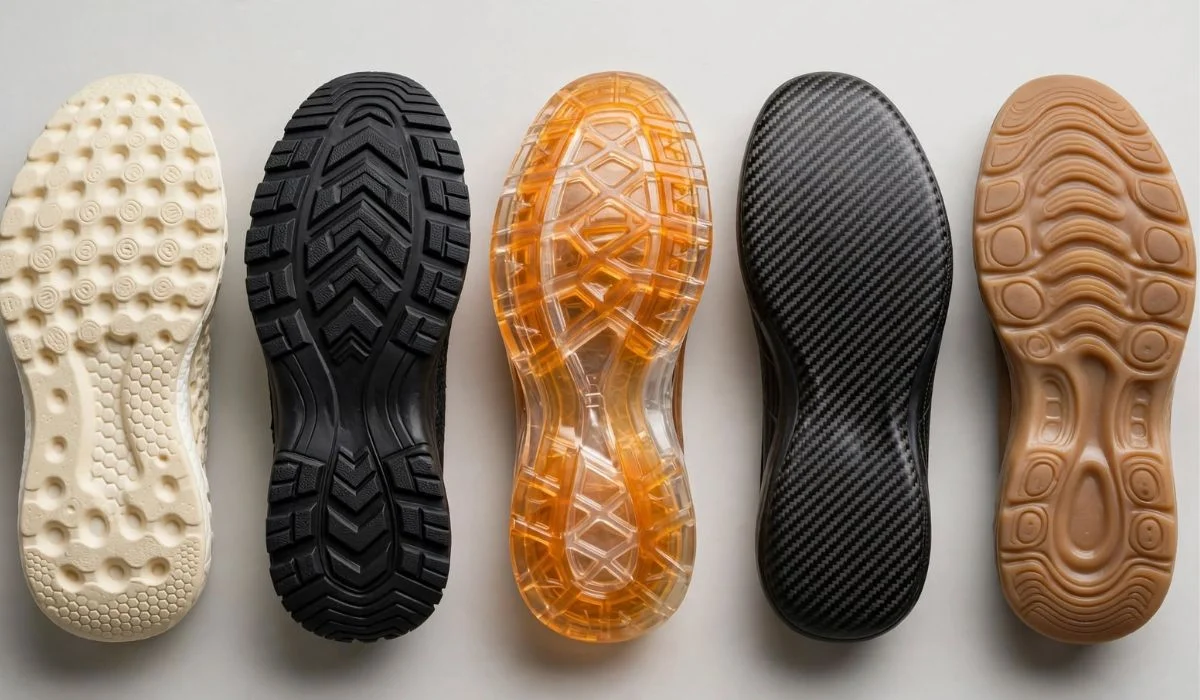
Common sole materials and designs include EVA foam, rubber, carbon rubber, blown rubber, TPU, PU, TPR, Phylon, lugged trail outsoles, and specialized court or cleat patterns.
Which sole is best for sports shoes?
There is no universal best sole. Running, basketball, tennis, soccer, volleyball, hiking, and gym training require different sole characteristics.
Is rubber better than EVA for sports shoes?
Rubber is generally more suitable for outsole traction and abrasion resistance, while EVA is commonly used for lightweight cushioning. Many sports shoes use both materials in different parts of the sole.
Which sole is best for running?
Road-running shoes commonly combine a cushioned foam midsole with rubber outsole sections. Trail-running shoes generally use a more aggressive tread designed for uneven outdoor surfaces.
What is the best sole for basketball?
A basketball shoe generally needs a durable, grippy rubber outsole with a tread pattern designed for indoor court movement. Lateral stability is also important.
Are EVA soles good for running?
Yes. EVA has been widely used in running footwear because it is lightweight and provides cushioning. Modern running shoes may also use other foam formulations with different performance characteristics.
Which sports shoe sole has the best grip?
Grip depends on the compound, tread pattern, surface, and conditions. Rubber is widely used when strong traction is required, particularly in court and outdoor footwear.
What is a non-marking sole?
A non-marking sole is designed to avoid leaving noticeable marks on indoor playing surfaces. Many indoor court shoes use non-marking rubber compounds.
Why do trail shoes have deep soles?
Trail shoes often have prominent lugs underneath the outsole to improve traction on loose, muddy, rocky, or uneven terrain.
Are harder soles more durable?
A harder outsole compound can provide better abrasion resistance, but durability depends on the entire material formulation and construction. Hardness alone does not determine how long a shoe will last.
What is a carbon rubber sole?
Carbon rubber is a rubber compound designed with carbon material to increase durability and resistance to abrasion. It is often used in high-wear areas of athletic shoe outsoles.
What is a TPU sole?
TPU, or thermoplastic polyurethane, is a synthetic material that can be used in outsole components and structural parts of sports shoes. It can offer durability, flexibility, and resistance to wear.
Are thick soles better for sports?
Not necessarily. Thick soles can provide substantial cushioning, but different sports require different levels of ground feel, stability, flexibility, and traction.
Can I use running shoes for basketball?
It is generally better to use basketball-specific footwear for regular basketball play. Running shoes are designed mainly for forward movement, whereas basketball requires frequent lateral movements, stops, and jumps.
How long do sports shoe soles last?
There is no fixed lifespan for every sports shoe. Usage frequency, surface, sole material, body weight, activity, and construction all affect wear. Visible tread loss, reduced traction, or damaged cushioning are useful signs that replacement may be needed.