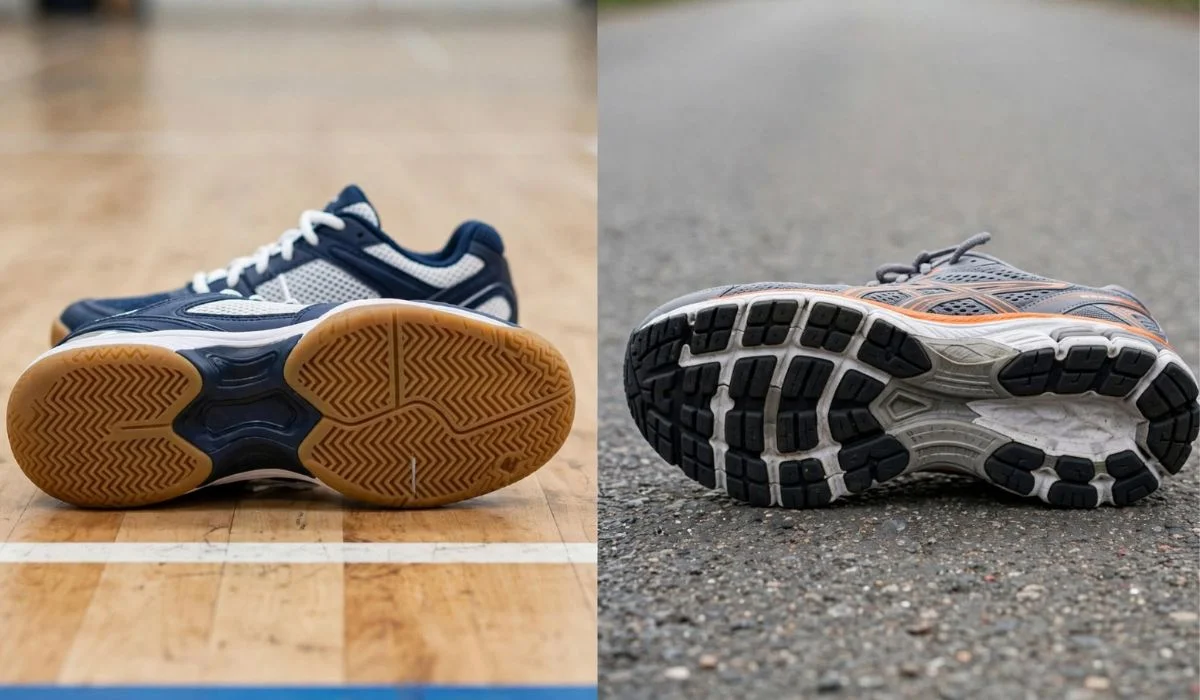
Badminton Shoes vs Running Shoes | A Complete Guide to Comfort, Durability, Cost, Maintenance, and Style
At first glance, badminton shoes vs running shoes may not seem like a major comparison. Both are athletic shoes, both can provide cushioning, and both are designed to make movement more comfortable. But they are built for very different types of movement.
Badminton involves quick lateral movements, sudden stops, lunges, jumps, and frequent changes of direction on a court. Running, on the other hand, primarily involves repetitive forward movement with different cushioning and stability requirements.
Because of these differences, wearing the right shoe for the activity can improve comfort, traction, and movement control.
Badminton Shoes vs Running Shoes at a Glance

| Feature | Badminton Shoes | Running Shoes |
|---|---|---|
| Primary movement | Side-to-side and multidirectional | Mostly forward |
| Court grip | High | Designed for running surfaces |
| Lateral stability | Strong | Usually less emphasized |
| Sole | Typically flat/non-marking indoor outsole | Running-specific outsole |
| Cushioning | Moderate and responsive | Often more substantial |
| Weight | Usually relatively light | Varies by model |
| Flexibility | Designed for court movement | Designed around running gait |
| Best use | Badminton and indoor court sports | Running and jogging |
The biggest difference is simple: badminton shoes are designed for court movement, while running shoes are designed for repetitive forward motion.
Why Are Badminton Shoes Different?
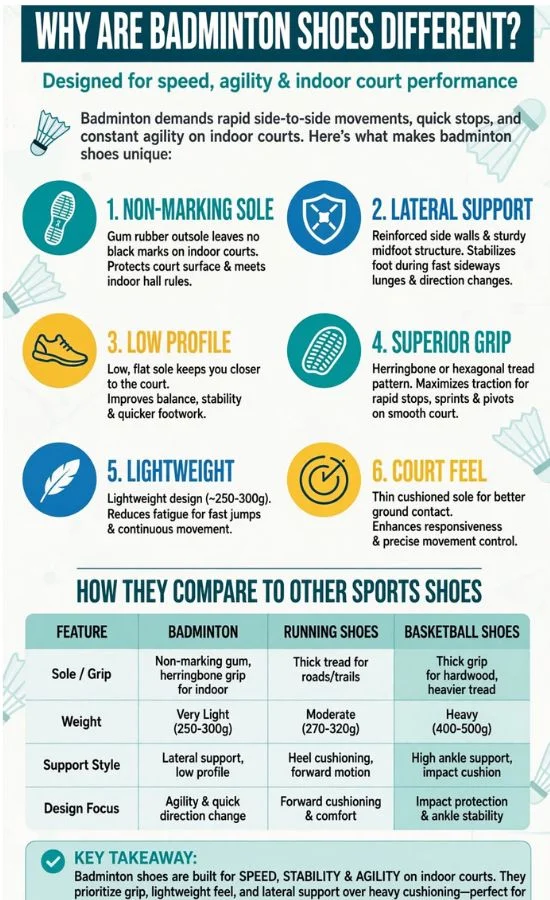
Badminton players rarely move in a straight line for long.
A typical rally can require a player to move forward, backward, sideways, diagonally, and suddenly stop before changing direction.
Badminton Requires Lateral Stability
When you lunge toward the side of the court, your foot needs to remain stable inside the shoe.
Badminton shoes are therefore designed with features that can help support side-to-side movement and quick changes of direction.
The Court Changes the Shoe Design
Indoor badminton courts are usually smooth surfaces.
Badminton shoes commonly use rubber outsoles designed to provide traction on indoor courts without leaving unwanted marks.
This grip is important when players need to stop or push off quickly.
Why Are Running Shoes Different?
Running shoes are designed primarily around the repetitive mechanics of running.
During a run, the body repeatedly absorbs and produces forces as the runner moves forward.
Running Shoes Emphasize Forward Movement
Running shoes commonly focus on:
- Cushioning
- Forward transitions
- Shock management
- Comfort
- Weight
- Running-surface traction
Their design can vary significantly depending on whether they are intended for road running, trail running, racing, or everyday training.
Can You Wear Running Shoes for Badminton?
You can physically play badminton in running shoes, but they aren’t usually the ideal choice.
Running shoes are generally designed for forward movement rather than rapid lateral changes.
The Main Problem Is Lateral Support
A running shoe may feel comfortable while jogging but behave differently when you suddenly move sideways.
The upper and sole geometry may not provide the same level of lateral stability as a dedicated court shoe.
During badminton, this difference can matter because players repeatedly accelerate, brake, lunge, and change direction.
Can You Run in Badminton Shoes?
You could use badminton shoes for very short casual walking or movement, but they aren’t designed specifically for running.
Running places repeated demands on cushioning and forward movement that badminton shoes aren’t necessarily engineered to handle.
Why They Aren’t Ideal for Running
Badminton shoes typically have a flatter, court-oriented outsole and a design optimized for indoor movement.
They may not provide the running-specific cushioning, geometry, and outsole characteristics you want for regular road running.
For consistent running, running shoes are generally the more appropriate choice.
Which Has Better Grip?
For indoor badminton courts, badminton shoes generally have the advantage.
Their outsole is designed specifically for traction on smooth indoor surfaces.
Why Court Grip Matters
Too little traction can make it difficult to stop and change direction.
Too much or inappropriate traction can also interfere with natural movement.
A badminton shoe aims to provide controlled grip suitable for the court.
What About Running Shoe Grip?
Running shoes are designed around the surface they are intended for.
Road-running shoes typically use outsoles suited to pavement and other relatively predictable surfaces, while trail-running shoes use more aggressive tread for uneven terrain.
Running Shoes Aren’t Designed for Indoor Courts
Even if a running shoe feels grippy, its outsole pattern and rubber compound aren’t necessarily optimized for a badminton court.
Some running shoe outsoles may also leave marks or provide an unsuitable interaction with a polished indoor surface.
Which Shoes Have Better Lateral Support?
For badminton, badminton shoes generally win.
The sport involves repeated lateral movements that require the foot to remain controlled during rapid direction changes.
Lateral Support Is a Major Design Priority
Badminton shoes may incorporate supportive upper materials, reinforced side areas, and wider or more stable platforms to help players move aggressively across the court.
Running shoes generally prioritize forward movement instead.
Which Provides More Cushioning?
Running shoes often provide more cushioning, but more cushioning doesn’t automatically make a shoe better for badminton.
Badminton requires a combination of cushioning, stability, court feel, and responsiveness.
Too Much Softness Isn’t Always Helpful
A very soft running shoe may feel comfortable during a jog but less stable during rapid lateral movement.
Badminton players often benefit from being able to feel the court and transition quickly between movements.
Which Is More Flexible?
Both types can be flexible, but they are flexible for different purposes.
Badminton shoes need to allow natural movement during lunges and rapid footwork.
Running shoes generally need flexibility that supports the running gait and forward transition.
Flexibility Should Match the Activity
A shoe isn’t better simply because it bends easily.
The important question is where and how the shoe flexes and whether that movement matches your activity.
Which Shoes Are Lighter?
Neither category has a universal weight advantage.
Modern running shoes range from lightweight racing models to heavily cushioned trainers. Badminton shoes also vary in weight depending on their materials and construction.
For badminton, however, lightweight construction can be useful because players need to move rapidly around the court.
Badminton Shoes Have a Lower Court Profile
Many badminton shoes have a relatively low-profile design.
This can help players maintain a closer connection to the court and make quick movements.
Why Does Court Feel Matter?
When you are reacting to an opponent’s shot, small changes in foot position can matter.
A shoe that provides good court feel can make movement feel more controlled and responsive.
Running Shoes Can Have Higher Stack Heights
Many modern running shoes use substantial amounts of midsole foam.
This can provide cushioning and comfort during running.
However, a taller platform can feel less stable during aggressive side-to-side movement.
Higher Cushioning Isn’t Automatically Bad
High-stack running shoes can be excellent for their intended purpose.
The issue is that running and badminton place different demands on footwear.
Which Shoes Are Better for Injury Prevention?
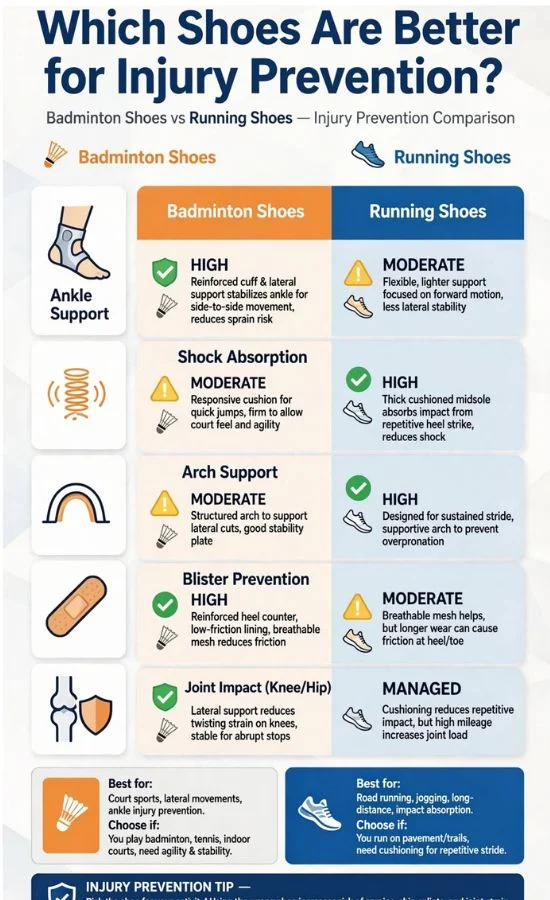
There is no shoe that can guarantee injury prevention.
However, using footwear appropriate for the activity can help provide the traction, stability, and cushioning suited to that movement.
For Badminton
A dedicated badminton shoe can provide:
- Appropriate court traction
- Lateral stability
- Secure fit
- Court-friendly cushioning
- Support during lunges
- Quick directional transitions
For Running
A running shoe can provide:
- Running-specific cushioning
- Suitable outsole traction
- Comfortable fit
- Forward-motion support
- Surface-specific design
The right shoe is only one factor in reducing injury risk. Training, technique, conditioning, recovery, playing surface, and workload also matter.
Read Next: Leather or Synthetic Leather Shoes Which Is Better | Cost, Maintenance, and Style
Badminton Shoes vs Running Shoes for Beginners
If you’re new to badminton, you may wonder whether your existing running shoes are good enough.
For occasional recreational play, you might manage temporarily with athletic footwear, but dedicated badminton shoes are a better long-term choice if you’re playing regularly.
Why Beginners Shouldn’t Ignore Footwear
Beginners often make frequent movements without having developed efficient footwork.
A suitable court shoe can provide a more appropriate platform for learning movement patterns.
Badminton Shoes vs Running Shoes for the Gym
The answer depends on what you’re doing at the gym.
If you’re primarily running on a treadmill, running shoes are generally more suitable.
If you’re playing badminton in an indoor court area, badminton shoes make more sense.
For Strength Training
Neither is necessarily the perfect choice for every lifting session.
Some strength-training activities benefit from a stable, relatively firm base rather than highly cushioned running footwear.
Your exercise selection should therefore influence your footwear choice.
Can Badminton Shoes Be Used for Walking?
Yes, you can walk in badminton shoes.
They may be comfortable for short periods, but their design is primarily intended for indoor court sports.
Don’t Treat Them as Everyday Walking Shoes Automatically
If you regularly walk long distances outdoors, a dedicated walking shoe or appropriate running shoe may be more practical.
Outdoor surfaces can also wear down indoor-court outsoles faster.
Can Running Shoes Be Used on a Badminton Court?
This is generally not recommended for regular play.
Running shoes may not provide the lateral stability and court-specific traction that badminton requires.
Their outsole can also be unsuitable for smooth indoor courts.
What Happens If You Play Badminton in Running Shoes?
The experience varies by shoe and player.
You may notice:
- Less lateral stability
- Different traction
- Reduced court feel
- More difficulty during quick direction changes
- A less secure feeling during lunges
The risk isn’t that every running shoe will immediately cause a problem. Rather, the shoe isn’t optimized for the movement demands of badminton.
How Should Badminton Shoes Fit?
Badminton shoes should feel secure without squeezing your feet.
Your heel should remain stable, while the toes should have enough room to move comfortably.
Check the Fit Before Playing
When trying them on:
- Wear your usual badminton socks.
- Stand and check toe room.
- Walk and perform gentle side-to-side movements.
- Check for heel slipping.
- Look for pressure points.
- Make sure your toes aren’t cramped.
- Ensure the shoe feels stable during a lunge-like movement.
What Should You Look for in Badminton Shoes?
If you’re shopping for badminton footwear, focus on the following:
Essential Features
Non-marking outsole: Important for many indoor courts.
Good lateral stability: Helps during side-to-side movement.
Secure heel fit: Reduces unwanted movement inside the shoe.
Appropriate cushioning: Provides comfort without sacrificing stability.
Breathable upper: Helps manage heat and moisture.
Flexible forefoot: Supports lunges and quick footwork.
Durable construction: Important for frequent play.
What Should You Look for in Running Shoes?
Your running shoes should match your running environment and personal preferences.
Important Considerations
Think about:
- Running surface
- Distance
- Training frequency
- Comfort
- Fit
- Cushioning preference
- Shoe weight
- Outsole durability
Road runners, trail runners, and track athletes can have very different footwear needs.
Which Is Better for Badminton: Badminton Shoes or Running Shoes?
For badminton, badminton shoes are the clear choice.
They are specifically designed around the sport’s lateral movements, quick stops, lunges, jumps, and indoor-court traction.
Running shoes may be comfortable, but their design priorities are different.
Which Is Better for Running: Badminton Shoes or Running Shoes?
For running, running shoes are the better option.
They are engineered for repetitive forward movement and running-specific demands.
Using badminton shoes for occasional short-distance movement isn’t necessarily a major issue, but they aren’t a substitute for proper running footwear if you run regularly.
Badminton Shoes vs Running Shoes: The Bottom Line
The biggest mistake is choosing shoes based only on cushioning or appearance.
Think about how your feet actually move during the activity.
Badminton requires rapid multidirectional movement, lateral stability, court traction, and responsiveness. Running requires footwear designed around repetitive forward motion, cushioning, and the specific running surface.
So, if you’re deciding between badminton shoes vs running shoes, use this simple rule:
Playing badminton? Choose badminton shoes.
Running regularly? Choose running shoes.
Using the appropriate footwear won’t guarantee perfect performance or prevent every injury, but it can give your feet a shoe designed for the movements they’re actually performing.
FAQs
Can I play badminton with running shoes?
You can, but running shoes aren’t generally recommended for regular badminton. They are designed primarily for forward movement and may not provide sufficient lateral stability or court-specific traction.
Are badminton shoes better than running shoes?
For badminton, yes. Badminton shoes are specifically designed for lateral movement, sudden stops, lunges, and indoor court surfaces. Running shoes are better suited to running.
Why can’t I use running shoes for badminton?
Running shoes are generally optimized for forward movement. Badminton involves frequent side-to-side movement and rapid direction changes, so a dedicated court shoe can provide more appropriate stability and traction.
Can I run in badminton shoes?
You can walk or move short distances in them, but they aren’t ideal for regular running. Running shoes are specifically designed for the repeated demands of running.
Do badminton shoes have better grip?
For indoor badminton courts, badminton shoes are generally designed to provide more appropriate grip. Their non-marking rubber outsoles are made for smooth court surfaces.
Are badminton shoes non-marking?
Many badminton shoes use non-marking outsoles designed for indoor courts. Always check the manufacturer’s specifications before using them on a particular court.
Do badminton shoes prevent ankle injuries?
No shoe can guarantee injury prevention. However, appropriate court footwear can provide traction and stability suited to badminton movements, which may support safer and more controlled movement.
Are running shoes more cushioned than badminton shoes?
Often, yes. Many running shoes use substantial cushioning because they are designed to absorb repeated forces during running. Badminton shoes balance cushioning with stability and court feel.
Can I use badminton shoes for the gym?
It depends on the workout. They can work for some indoor activities, but they aren’t necessarily ideal for running, heavy lifting, or every type of gym exercise.
Which shoes are better for walking, badminton or running?
For regular walking, a comfortable walking or running shoe is usually more appropriate. Badminton shoes are primarily designed for indoor court movement rather than long-distance walking.
Should badminton shoes be tight?
They should be secure but not painfully tight. Your heel should stay relatively stable, while your toes need enough room to move without being squeezed.
Why do badminton shoes have flat soles?
A relatively low-profile sole can improve stability and court feel during rapid movements. Badminton players need to move quickly in multiple directions rather than primarily forward.
Are expensive badminton shoes worth it?
Price alone doesn’t determine performance. A suitable fit, stable construction, appropriate traction, comfortable cushioning, and durability are more important than simply choosing the most expensive model.
What is the biggest difference between badminton shoes and running shoes?
The biggest difference is the movement each shoe is designed to support. Badminton shoes emphasize multidirectional court movement and lateral stability, while running shoes primarily support repetitive forward movement.