How Are Shoes Made In A Factory | Materials to Assembly and Quality Control
Have you ever wondered how shoes are made in a factory? A modern pair of shoes may look simple from the outside, but manufacturing involves dozens of carefully coordinated steps. Designers, material suppliers, pattern makers, cutting machines, stitching operators, molding equipment, assembly workers, and quality-control teams can all contribute to the finished product.
Although manufacturing methods vary by shoe type, most factory-made footwear follows a general process: design and development, material preparation, cutting, stitching, sole production, assembly, finishing, inspection, and packaging. Here’s what happens behind the scenes.
Where Does Shoe Manufacturing Begin?
Before a shoe reaches the factory floor, its design has already gone through considerable development.
Manufacturers first determine the intended purpose of the footwear. A running shoe, leather dress shoe, hiking boot, sandal, and casual sneaker require different materials, shapes, construction methods, and performance characteristics.
Designing the Shoe
Designers create the overall appearance of the shoe while considering practical requirements such as:
- Shape and proportions
- Materials
- Comfort
- Flexibility
- Durability
- Weight
- Traction
- Intended use
- Target price
Modern footwear companies may use computer-aided design software to develop patterns and three-dimensional concepts before physical samples are produced.
Creating a Shoe Last
A shoe last is a solid form shaped roughly like a human foot. It provides the foundation around which the shoe is constructed.
The last determines important characteristics such as the shoe’s length, width, toe shape, heel height, and overall fit.
Different sizes require appropriately scaled lasts so the finished shoes can be produced in a range of sizes.
What Materials Are Used to Make Shoes?
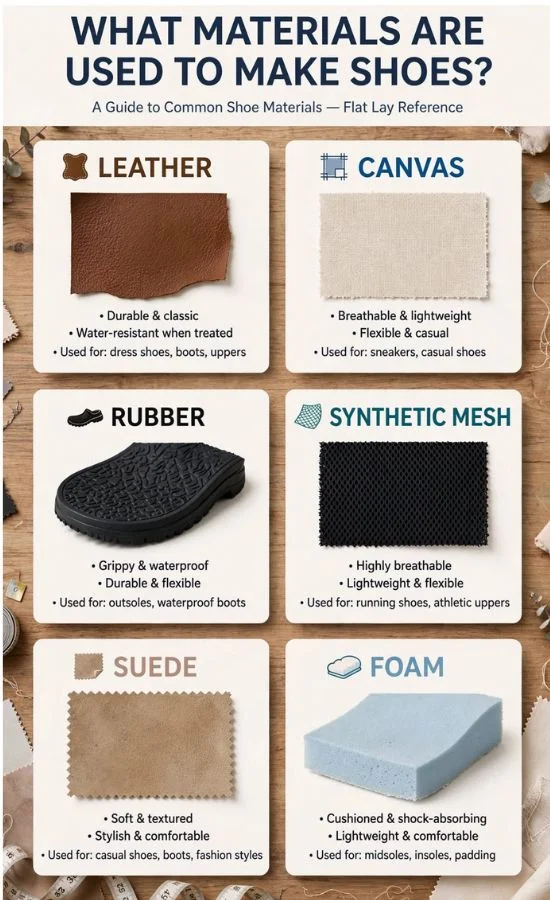
Shoes can contain several different materials, depending on their design.
Common materials include:
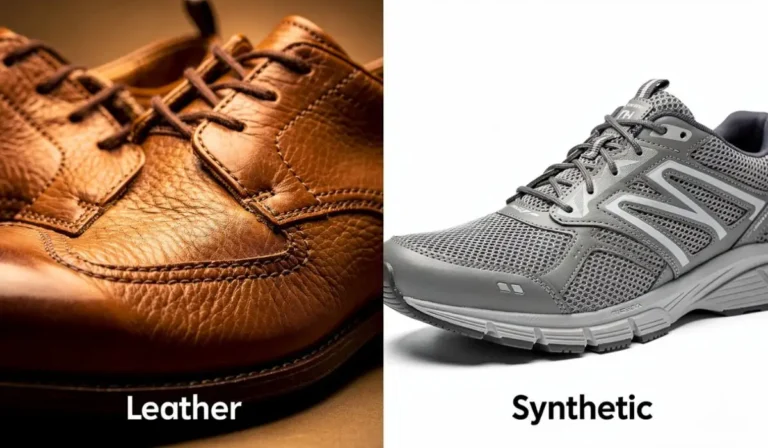
- Leather
- Synthetic leather
- Textile fabrics
- Mesh
- Rubber
- EVA foam
- Polyurethane
- Thermoplastic materials
- Adhesives
- Thread
- Metal or plastic components
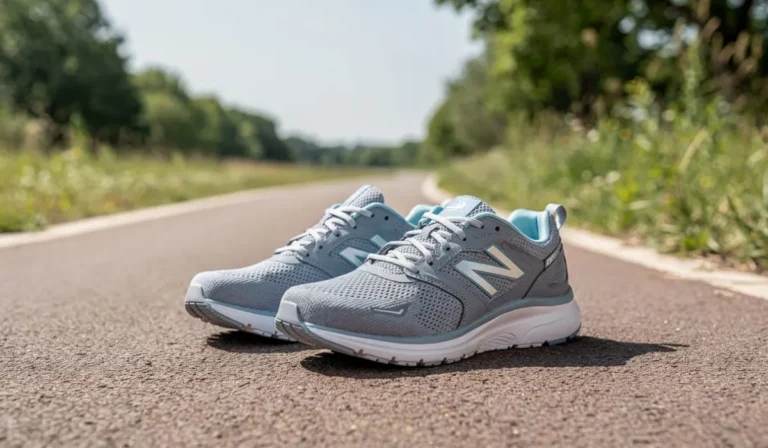
A single sneaker, for example, may combine mesh, synthetic overlays, foam cushioning, rubber, textile lining, and adhesives.
Upper Materials
The upper is the portion of the shoe that covers and holds the foot.
It may be made from leather, mesh, canvas, synthetic materials, knitted textiles, or combinations of several materials.
Sole Materials
The sole is designed to provide cushioning, protection, flexibility, and traction.
Different footwear manufacturers use different combinations of rubber, foam, molded plastics, and other materials depending on the shoe’s intended purpose.
Step 1: Creating the Shoe Pattern
The manufacturing process generally starts with patterns that define the shapes of the individual upper components.
A shoe isn’t usually cut from one large piece of material. Instead, the upper consists of multiple sections that are later joined together.
Why Are Patterns Important?
Patterns determine how the pieces fit together.
They account for things such as:
- Seam allowances
- Stitching locations
- Panel shapes
- Eyelet positions
- Tongue dimensions
- Collar construction
- Decorative details
A small pattern error can affect the appearance or fit of the finished shoe.
Step 2: Inspecting and Preparing Materials
Before cutting begins, materials are inspected for defects.
Leather may be checked for scars, wrinkles, thickness variations, and other imperfections. Fabrics may be examined for holes, color differences, or weaving problems.
Materials Are Prepared for Cutting
Large rolls of textile or synthetic material may be spread out in layers. Leather pieces may be arranged carefully to make efficient use of the available surface.
Factories try to minimize material waste because inefficient cutting can increase manufacturing costs.
Step 3: Cutting the Shoe Components
Once the patterns are ready, factory workers or automated cutting systems cut the materials into individual components.
Cutting methods depend on the material and production setup.
How Are Shoe Pieces Cut?
Factories may use:
- Mechanical cutting dies
- Computer-controlled cutting machines
- Laser cutting systems
- Automated cutting equipment
- Manual cutting methods for selected materials
The resulting pieces may include vamp sections, quarters, tongues, collars, overlays, lining pieces, and decorative components.
Read Next: What Shoes Are good For Posture | Comfort, and Better Walking Support
Step 4: Marking and Preparing the Pieces
After cutting, individual components may receive markings that indicate where they need to be stitched, folded, punched, or attached.
These markings help workers position components accurately.
Holes and Decorative Details Are Added
Depending on the shoe design, factories may punch holes for laces, add perforations, emboss logos, or prepare openings for other components.
Some decorative details are applied before the upper is assembled because accessing those areas later may be more difficult.
Step 5: Stitching the Upper
Now the separate pieces begin to look like a shoe.
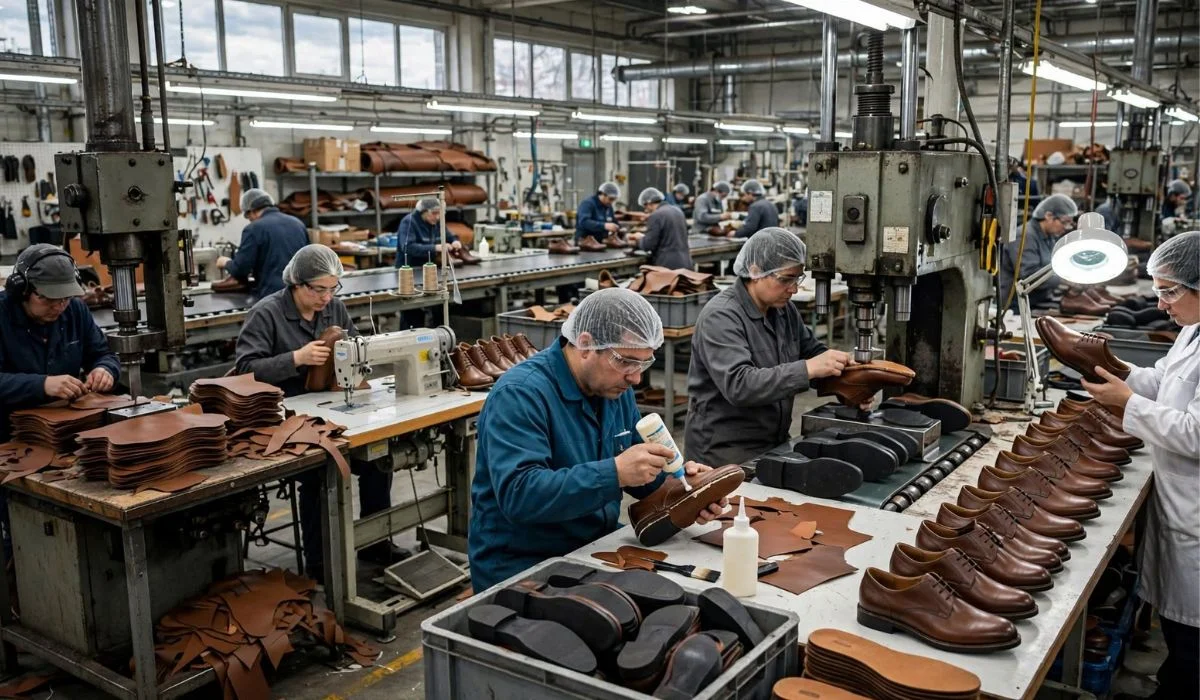
Workers use industrial sewing machines to join different sections of the upper.
Different Parts Are Sewn Together
The stitching process may involve attaching:
- Toe panels
- Side panels
- Heel sections
- Tongues
- Collars
- Overlays
- Linings
- Reinforcement pieces
The exact sequence varies according to the construction of the shoe.
Why Is Stitching So Important?
Stitching contributes to both appearance and structural strength.
Poorly positioned stitches can create uneven seams, weak points, or uncomfortable areas inside the shoe. Factory workers therefore need precision and consistency.
Step 6: Adding Reinforcements and Hardware
Some shoes require additional components before the upper is attached to the sole.
These may include:
- Eyelets
- Heel counters
- Toe reinforcements
- Foam padding
- Webbing
- Hooks
- Decorative logos
- Lace components
The specific components depend on the footwear design.
Step 7: Preparing the Sole
While the upper is being assembled, another part of the factory may be producing the outsole and midsole.
This is one of the most interesting parts of learning how are shoes made in a factory, because modern soles can be produced using several different manufacturing techniques.
How Are Rubber Soles Made?
Rubber compounds can be shaped using molds. Heat and pressure may be used to form the material into the desired outsole design.
The mold creates features such as:
- Tread patterns
- Grooves
- Logos
- Edges
- Flex points
Once formed and cooled or otherwise processed as required, the sole components can be prepared for assembly.
How Is Foam Cushioning Made?
Many athletic shoes use foam materials in their midsoles.
Foam can be molded into a specific shape designed to provide cushioning and support. Different foam formulations can produce different levels of softness, resilience, and weight.
Step 8: Lasting the Shoe
One of the key stages in shoe production is called lasting.
During lasting, the upper is positioned over the shoe last so it takes the intended three-dimensional shape.
What Happens During Lasting?
The upper is pulled and secured around the last.
Depending on the construction method, the upper may be attached temporarily or permanently to the bottom structure at this stage.
This process helps establish the final shape of the footwear.
Step 9: Attaching the Upper to the Sole
Once the upper has been shaped, it must be joined to the sole.
Different shoe construction methods use different attachment techniques.
Cemented Construction
In cemented footwear, adhesives are commonly used to bond the upper and sole components together.
This method is widely used in sneakers and many casual shoes because it can support efficient mass production.
Stitching and Other Construction Methods
Some footwear uses stitching as part of the sole attachment process. Other designs combine stitching, adhesives, molding, or mechanical attachment.
The choice depends on the shoe’s design, performance requirements, cost, and intended use.
Step 10: Pressing and Setting the Sole
After the sole is positioned, machinery may apply pressure to ensure a strong and consistent bond.
The shoe may then go through a setting or curing process depending on the adhesive and construction method.
Why Does Pressure Matter?
Proper contact between the upper and sole is essential.
Insufficient bonding can result in gaps or separation, while uneven pressure may affect the appearance or construction of the shoe.
Step 11: Removing the Last
After the shoe has acquired its final shape and the construction has sufficiently set, the last is removed.
The footwear should now retain its intended three-dimensional form.
The Shoe Starts Looking Finished
At this point, the shoe resembles the product consumers see in stores, although several finishing and inspection stages remain.
Step 12: Cleaning and Finishing
Manufactured shoes can have small marks, excess adhesive, loose threads, or other minor imperfections that need attention.
Workers inspect the footwear and perform finishing operations.
Common Finishing Tasks
These may include:
- Trimming loose threads
- Removing excess adhesive
- Cleaning surfaces
- Smoothing edges
- Adding insoles
- Installing laces
- Applying final logos
- Checking decorative details
The exact finishing process varies by shoe type and manufacturer.
Step 13: Quality Control
Quality control is one of the most important stages of factory shoe manufacturing.
A finished pair may be inspected for consistency, appearance, construction, and basic functional requirements.
What Do Inspectors Look For?
They may check:
- Stitching quality
- Sole attachment
- Surface defects
- Color consistency
- Correct sizing
- Symmetry
- Loose components
- Glue marks
- Material defects
- Overall appearance
Factories can use both human inspection and automated systems to identify defects.
Step 14: Testing the Shoes
Some footwear undergoes additional testing depending on its intended purpose.
Athletic, safety, work, hiking, and specialized footwear may be tested for specific performance characteristics.
What Can Be Tested?
Depending on the product, manufacturers may evaluate:
- Abrasion resistance
- Flexibility
- Sole adhesion
- Slip resistance
- Cushioning characteristics
- Material durability
- Water resistance
- Structural strength
Not every shoe receives every type of test. Testing requirements depend on the product and applicable standards.
Step 15: Pairing and Packaging
Once shoes pass inspection, they are paired according to size, color, style, and other product specifications.
They are then prepared for shipment.
What Happens Before Shipping?
The final shoes may be:
- Inserted with tissue paper or supports.
- Laced or adjusted.
- Placed into shoe boxes.
- Labeled with product information.
- Packed into larger shipping cartons.
- Sent to warehouses, retailers, or distribution centers.
From there, the shoes eventually make their way to consumers.
How Long Does It Take to Make a Pair of Shoes?
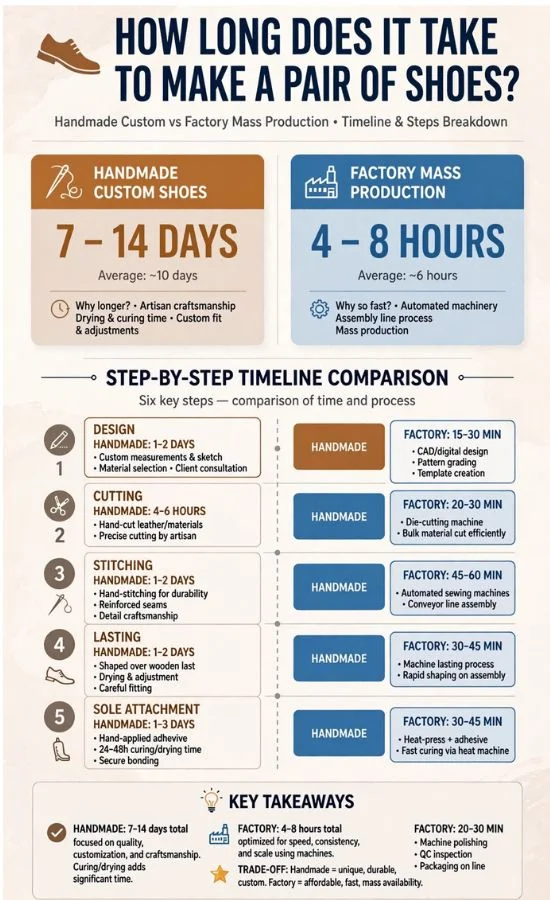
There isn’t one universal production time.
The process can range from highly automated operations to labor-intensive manufacturing involving many individual steps. Shoe complexity, factory capacity, production volume, materials, construction method, and quality-control requirements all influence the timeline.
A basic mass-produced shoe and a handcrafted leather shoe can have dramatically different manufacturing processes.
How Are Sneakers Made Differently?
Sneakers often involve multiple materials and specialized components.
A typical athletic sneaker may include a textile or mesh upper, synthetic reinforcement panels, foam cushioning, rubber outsole sections, a tongue, lining, laces, and various adhesives.
Why Do Sneakers Have So Many Layers?
Different layers perform different jobs.
One material may provide breathability, another structural support, another cushioning, and another traction.
Manufacturers combine these components to create a shoe designed for a particular activity.
How Are Leather Shoes Made in a Factory?
Leather footwear follows many of the same broad stages but requires additional material handling.
Leather is inspected and cut according to patterns before individual components are stitched together.
Leather Requires Careful Cutting
Natural leather can vary in texture and appearance across the hide.
Manufacturers therefore need to position patterns strategically to reduce defects and use the material efficiently.
Depending on the construction, leather shoes may also involve processes such as skiving, folding, edge finishing, lasting, stitching, and sole attachment.
How Much of Shoe Manufacturing Is Automated?
Modern footwear factories can use significant automation, but the amount varies greatly.
Machines can perform cutting, molding, pressing, sewing, and other repetitive tasks, while skilled workers may still handle assembly, inspection, finishing, and processes requiring judgment or dexterity.
Why Don’t Factories Automate Everything?
Shoes contain flexible materials with varying thicknesses, textures, and shapes. Some operations require precise manipulation that can be difficult to automate completely.
As a result, footwear production often combines machinery with human labor.
Why Are Shoes Made in Different Countries?
Footwear manufacturing is a global industry.
Companies may design products in one country, source materials from several locations, manufacture them elsewhere, and distribute them internationally.
Manufacturing Location Depends on Several Factors
Businesses consider:
- Labor availability
- Production capacity
- Material supply chains
- Manufacturing expertise
- Infrastructure
- Transportation
- Production costs
- Market demand
The country listed on a shoe’s label therefore doesn’t necessarily tell the whole story of its supply chain.
Can Shoes Be Made From Recycled Materials?
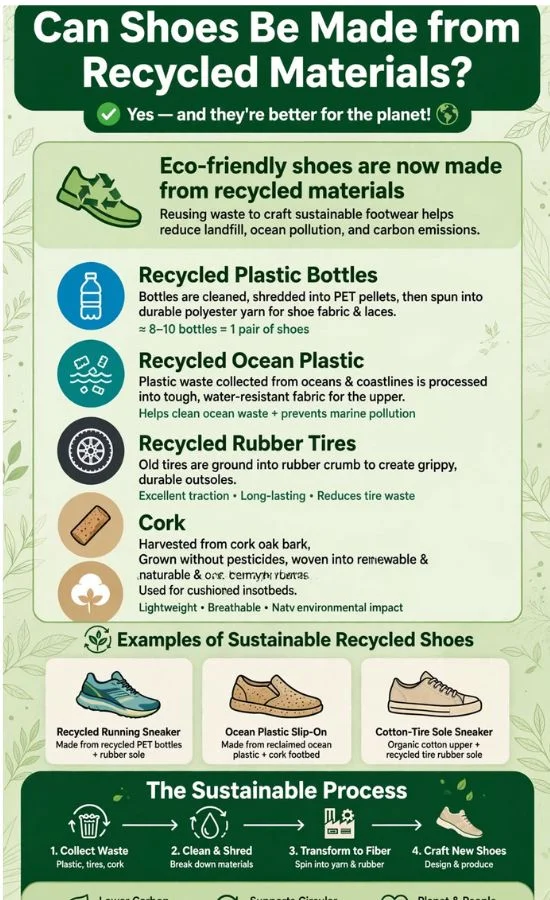
Yes. Some footwear manufacturers use recycled polyester, recycled rubber, reclaimed materials, and other recycled inputs.
The exact percentage of recycled material depends on the product.
Sustainability Doesn’t Depend on One Material
A shoe’s environmental impact can involve many factors, including raw material production, manufacturing energy, transportation, product lifespan, and disposal.
A durable shoe that remains useful for a long time may reduce the need for frequent replacement.
What Happens to Defective Shoes?
Factories have procedures for handling products that fail inspection.
Depending on the type and severity of the defect, a shoe may be repaired, reworked, downgraded, recycled, or rejected.
Manufacturers aim to reduce defects because wasted materials and labor increase production costs.
The Complete Shoe Manufacturing Process at a Glance
The process can be simplified into this sequence:
Design → Pattern Making → Material Inspection → Cutting → Component Preparation → Stitching → Sole Production → Lasting → Sole Attachment → Pressing → Finishing → Quality Control → Testing → Packaging → Distribution
Not every factory follows precisely the same sequence. Construction methods and shoe categories can add or remove individual stages.
Final Thoughts
Understanding how shoes are made in a factory reveals just how much work goes into an everyday pair of footwear. What looks like a simple product is actually a combination of carefully shaped materials, stitching, molded components, adhesives, machinery, and skilled labor.
From the first pattern and material cut to the final quality inspection, each stage contributes to the shoe’s fit, appearance, durability, comfort, and performance. Whether you’re looking at a sneaker, leather dress shoe, work boot, or casual sandal, the manufacturing process reflects a combination of design decisions, engineering, materials, and production techniques.
FAQs
What is the first step in making shoes?
The process begins with product design and development. Manufacturers establish the shoe’s shape, materials, construction, intended use, and specifications before production begins.
What is a shoe last?
A shoe last is a foot-shaped form used during footwear construction. It determines much of the shoe’s shape, size, and fit.
How are shoe uppers made?
The upper is usually created by cutting multiple material pieces according to patterns and stitching or joining those pieces together. Additional components such as padding, eyelets, and reinforcements may then be added.
How are shoe soles manufactured?
Soles can be produced using molding, cutting, compression, or other processes depending on the material and shoe design. Rubber, foam, and other materials can be shaped into specific sole components.
What does lasting mean in shoe manufacturing?
Lasting is the process of shaping the shoe upper around a shoe last. It helps establish the final three-dimensional shape of the footwear.
Are shoes made entirely by machines?
No. Modern factories may use extensive machinery and automation, but human workers can still perform stitching, assembly, finishing, inspection, and other tasks.
Why do shoes need quality control?
Quality control helps identify problems such as incorrect sizing, loose stitching, sole separation, material defects, glue marks, and appearance inconsistencies before products reach consumers.
How are sneakers manufactured?
Sneakers are typically made by combining several components, including a fabric or synthetic upper, cushioning materials, outsole sections, lining, reinforcements, and laces. These components are cut, assembled, stitched, molded, bonded, finished, and inspected.
How are leather shoes made?
Leather shoes are made by inspecting and cutting leather according to patterns, preparing and stitching the upper components, shaping the upper over a last, attaching the sole, and completing finishing and quality-control processes.
How many parts are in a shoe?
There is no fixed number. A simple shoe may have relatively few components, while a technical sneaker or boot can contain many individual pieces of fabric, foam, rubber, reinforcement, hardware, and other materials.
Can shoes be made from recycled materials?
Yes. Some footwear incorporates recycled materials such as recycled polyester or rubber. The amount and type of recycled content varies between products.
Why are shoes manufactured in factories?
Factories allow footwear to be produced at larger volumes with consistent sizing, construction, quality control, and production efficiency. Different factories use different combinations of automation and skilled labor.